Action value in prelimbic cortex
Foraging behavior, and brain-wide recordings of PL and its inputs
Ongoing analysis, with Yoni Browning, Camille King, Karel Svoboda and Josh Siegle.
In the dynamic foraging task, mice choose between two water spouts whose reward probabilities change in hidden blocks. Neurons in medial prefrontal cortex track the difference and the sum of the two spouts’ values, and silencing the region biases choice (Bari et al. 2019). To ask where those value signals come from, we used brain-wide, MRI-guided recordings of prelimbic cortex (PL) and its anatomical inputs while mice foraged.
Mice judge only the spout they are on
Mice choose one spout in long runs, and whether they leave depends on that spout’s odds alone. In held-out model comparison, a one-variable compare-to-threshold model fits them better than the published reinforcement-learning models that track both spouts, which come close only by forgetting the spout the mouse is not using.
Rewritten so its parameters read directly, the model keeps a single quantity, stay credit. Each outcome moves stay credit toward the worth of a win or of a loss, and the mouse leaves when it runs low. Even a loss pulls the mouse to stay a little.
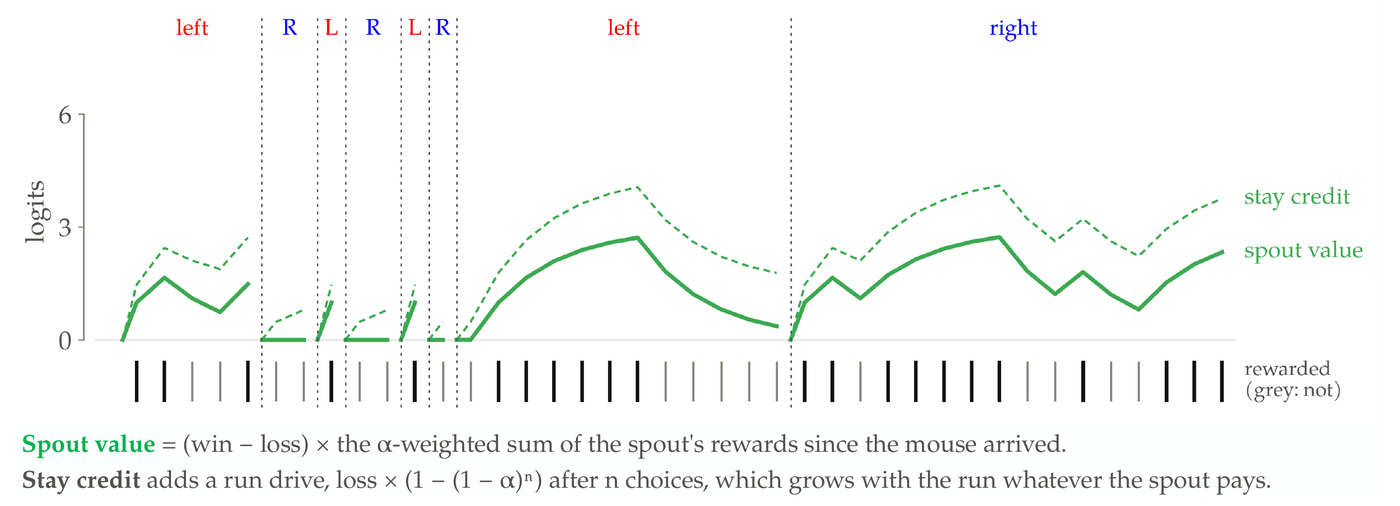
PL and its inputs carry the spout’s reward history
Before each choice, PL’s population carries the current spout’s reward history, reaching back past the last outcome, as do several of its inputs. Before a switch, value decoded from PL and mediodorsal thalamus falls about as far as the model predicts. From trial to trial, PL’s value signal moves with the value signals of many input regions. In a subset of recordings, cross-correlograms identify putative monosynaptic connections onto PL neurons from the input subregions we targeted.
A region that represents value is not necessarily one the circuit uses to choose. We’re now asking which inputs share PL’s value signal beyond what shared movement explains, and how that signal relates to the moment a mouse decides to leave.